Saturday, March 08, 2008
At the CreativeCamp in Kilkenny
I guess it was from Ken McGuire's blog.
There is a dedicated webpage, and the #podcamp jaiku channel was used for the day.
Ken also posted a couple of pictures of the venue - the Parade Tower of he Kilkenny Castle on Flickr. Hope to see more posted on the following days (my own camera decided to break after the first picture).
These were the organisers: Ken McGuire, Tom Corcoran, Keith Bohanna, and this the venue: Kilkenny Castle.
The audience was very mixed: artists, geeks, start-up people, bloggers, and so forth. 120 people have registered, but probably there were up to 80 attendees.
And these are my (slightly edited) notes from the event:
Ina O'Murchu - Personalisation and The Social Web
The Square Room is too small - many people want to listen to Ina's talk.
Ina: are you using iGoogle? iLike? - Ali interviewed on Intruders.TV - he confessed he didn't expect that viral spread through Facebook- had to get more servers.
Nike + iPod-nice combination - power song for the last mile. Personal as well as social!
Mashups - one of the best last year - Snow Patrol+Police.
(I just noticed the online program keeps on changing - bernie and walter are now down for 11am!)
Consumers are not listening anymore.
Nine Inch Nails - Ghosts I-IV - cutting out all the middlemen - sold everything and made a lot of money.
It is much easier to do for established artists - money are not being made on music anymore - but on the add-ons.
Our lives are exposed - We're constantly connected.
Nova Spivack presented this week at DERI Twine - a knowledge networking application -there's a Twine Preview on YouTube.
It is a bit like Wikipedia - but based on the Semantic Web.
(time for me to discover Nova's talk in DERI)
There are many others out there:
TripIt - for organising trips
Hakia - search for meaning
Ina promises the audience to upload the slides on her blog.
Comments from the audience - daughter on Bebo and Facebook - but still using texting a lot.
Someone working with O2 - works on mobile portals - Bebo and Facebook took off on mobile phones. There are 2000 iPhones on Vodaphone in Ireland!!!
Damien Beresford on Outsourcing Your Personal Workload(11am Ormond Room)
He gave this presentation at the Open Coffee in Waterford yesterday. He was formerly with Iona. Now with tax123.ie
What do they outsource: graphic design, search engine optimisation, testing, java scripts, small chunks of tax123.ie.
Some of their negotiated tariffs: tester 13$ per day; graphic designer 8$ per icon;Java PHP $18 per day; Search Engine Optimisation $500 ongoing (one-off fee) Phillippines
Value compared to your time (~2/15split); it is 1/26 in manufacturing.
You still need to spend time - defining the requirements - selecting a person, checking the work.
You're the only one responsible for what you get back!
How: via conduit, guru.com, rentacoder.com, elance.com, getafreelancer.com.
They're all electronic market places - guru.com being the biggest.
You also need to solve the IP problem- signing an NDA with a person abroad might not be very effective. Resources to follow up are also needed.
Tips:
New project - requirements, tests, questions in the specifications, definitive outputs, engage & check profile; repeat work is easier.
Damien explains how these sites work: the intermediary keeps the money until the work gets done; an arbitration system is also provided.
Once he tried to avoid rent-a-coder - they take out 15% of the price. But because Paypal is not accepted in some countries, the hassle of having to go to the bank made him give up.
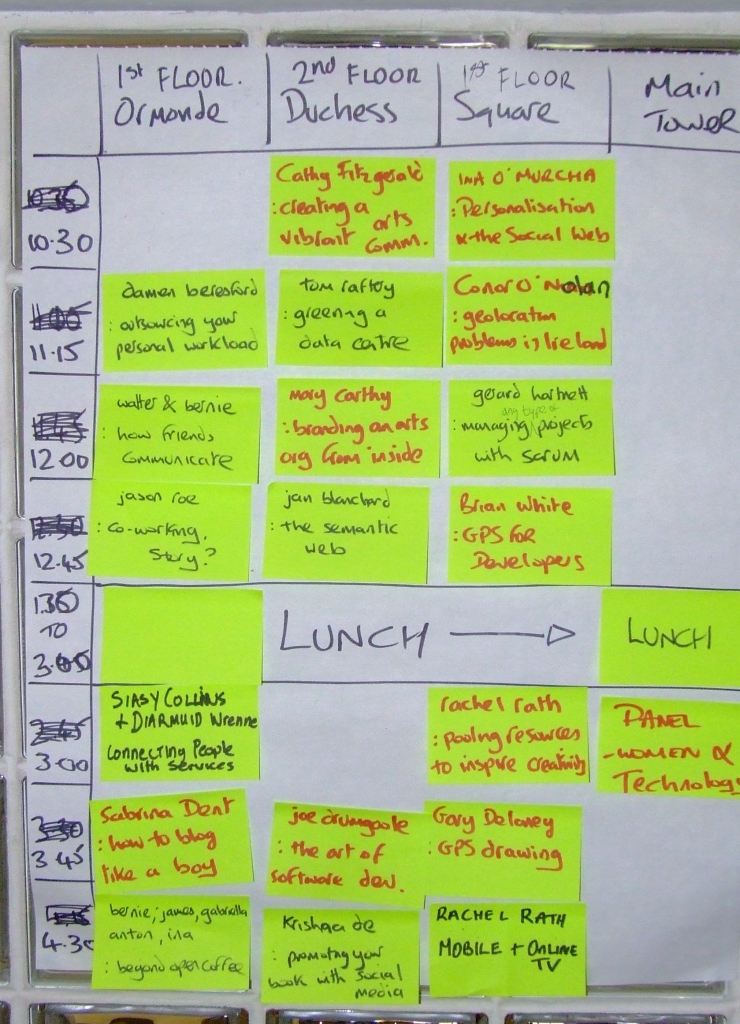
On the Jaiku channel, Ken McGuirre shares a link to a pic of the day's programme.
Here's how it looks like:
 Finally, Damien makes some reading recommendations:
- The Economist
- "The world is flat" by Thomas Friedmann
- Evalueserve: Person to person offshoring
- Case studies on Elance
- The 4 hour work week- Timothy Ferris
Siasy Collins and Qamir Hussain contributed to the discussion, sharing insights from their own experience.
Someone expressed concerns about handling IPR - outsourcing chunks of work to different people seems to work well.
Working with Sri Lanka and India proved to create complications when a company is on the point of getting bought out - you have to prove you have the IPRs, and this is acknowledged as well by the other side, and accepted by the laws
of their country.
Ger Hartnett - coclarity - Managing Any Kind Of Project With Scrum (Square Room, 11:45)
SCRUM - American named it so- looks like they had no clue about rugby;)
Description of SCRUMS - all projects have chickens and pigs. Ger mentions an old joke in which a chicken and a pig are talking and the chicken says, "Let's start a restaurant." The pig replies, "Good idea, but what should we call it?" "How about 'Ham and Eggs'" says the chicken. "No thanks," says the pig, "I would be committed to the project, but you would be nearly involved."
Ger used to work for Intel, converting caffeine into code.
The audience seems to come half from a creative background and half from the software industry (not that one excludes the other!).
Working in SCRUMs means frequent samples and small adjustments.
It is more about adaptability than about predictability.
Ideally for small teams - max 6 people. On a 35 people project - they split in 6 teams.
The people are ideally collocated, but there are ways to cope with distribution.
Every big project gets broken down into sprints; each sprint takes max 1 month; they keep a list of work items called backlog; at the start of each sprint - the team pick items from the backlog.
SCRUMs are about balancing the team's ability to focus with adaptability and ability to change.
Daily short meetings are hold; it is easier to focus on something that's a month away;
the daily meeting is 15 min max same time same place standing. 3 questions for everyone:
- what did you do in the last day (binar answer- done or not done)
- what roadblocks you encountered? how can others help?
- what will you do by tomorrow?
They use a highly advanced technology: loads of post-its stuck to a big sheet of paper:)
On the big sheet of paper:
- upper part - people
- lower part - current backlog, backlog, done
People are occasionally walking to the room to see where they are - for distributed projects you need a different solution. (3M make loads of money because people use so many post-its!!!-joke)
Managers still want a Microsoft Project document. Dealing with this is relatively simple - plan is a series of sprints; dependencies only at a sprint level.
Tracing a task list with a spreadsheet - in Ger's paper with Brian Fitzgerald- an example.
After the big chickens get to trust the team - they can do with less reporting;
everyone gets involved in planning and tracking, team "gells"
Further readings: The Wikipedia article on SCRUM.
Joe Drumgoole - people at PutPlace use TRACK. Other available tools: Lighthouse,mingle.
You can put tickets in if you take some out - otherwise you can't get all the tasks done and a sense of guilt develops.
White band Delphi - code reviews for estimates - Eurovision mashed up with code reviews:)
Q: how can you deal with roadblocks in 15 min? you don't solve the problem - you just state it - but you take it offline to solve it.
There is a person in SCRUMs who's half chicken -half pig. He reports to the chickens.
Every success is celebrated with roast chicken - Joe Drumgoole:)
Slides will be up on slideshare - promises Ger Hartnett.
Coworking -Jason Roe
He used to be a freelancer - web developer - he was working from home - and it was quite difficult. After a while, home seems a very lonely place and you can't do it anymore.
It was very expensive to get an office - he didn't need 3-5 people.
What he needed was to add some structure to his work. A lot of the customers were not based in Ireland - so meeting with the customers wasn't feasible.
Working from home - your days start to go into each other -they seem to run over and over and over. He looked at what was going on in different places in the US.
www.coworking.ie - was set up about 18m ago
He wanted to see if there was a demand out there for cafe like collaboration spaces.
In other countries, freelancers would meet up in cafes/bars to work. What people need is flexibility on costs and flexibility on committments. 15 bloggers support the site currently.
It is not an office share!
There are a few places for co-working right now:
- Space 28 set up by Paul Cable Jul 07 dublin
- Broombridge in assoc with Jason Feb 2008 Dub
- Waterford Institute - co-working ethos
A need to show how co-working differs in Ireland - to date. It's a matter of finding the other people who are interested.
In Waterford - the coworking location is part of the business incubator - 7 people who wanted to work together. Each person has an individual licence agreement - they can be in /out in 30 days.
There is scope for other institutes to do it. A lot of cross working going on - people mingle.
What is needed is a building or a landlord with a building; there are pros and cons of taking a lease - advantages of partnering; benefits for the landlord
Spaces can be a slow process to get off the ground; you need to find other interested people in your area.
Personally, I don't like this idea - where's the freedom? the fluidity? the serendipity?
The same people are meeting every day - that's not what the digital bohemians concept is all about.
They did a survey on coworking.ie. The results are here.
A long lunch break followed - while the others were watching the rugby match on the big screen, I went out for a stroll - the castle has beautiful grounds and the weather was absolutely glorious!
I got back on time for the last 20 min of the Vultures screening ( episode 1"Kris Kringle Konundrum"). More about its history and context here.
The Women in Technology panel is next. Krishna De is facilitating it - she mentions the International Women's Day. The ladies on the panel:
- Ina O'Murchu - ex DERI - currently working with a start-up.
- Martha Rotter - Microsoft Ireland -helping companies across Ireland to adopt internet technologies
- Sabrina Dent - web designer and Internet marketer
- Elly Parker - better known as "ellybabes"
Krishna De: question for Sabrina - What is the impact of blogging on your reputation as a freelancer?
Sabrina: She wrote a lot about travelling - then she was hired as professional blogger for a start-up that eventually failed - but her reputation as a blogger brought her a lot of work as web designer.
for Martha - How is it to blog from inside a big organisation?
She started blogging as a channel for interacting with people she needed to reach out to - getting useful feedback via the blog.
Sabrina: blogging also brings more transparency to her work.
Elly : putting a face to a name.
Ina: She is planning a change for marking a transition from the semantic web niche to internet marketing (her new job).
for Elly: How did micro-blogging affect your blogging?
Elly: Twitter is a sort of permanent Irish backchannel - Ireland being small enough, you can follow a lot of the people. She tracks about 150 people - this is how she's finding out about events. For example the GGD - Martha, can you tell more about it?
Martha: The Girl Geek dinner started in London 2y ago. Girl geeks usually don't want to go to events, because they don't know anyone. The purpose was creating a network of women.
The first one in Ireland happened in Dublin last week, the next will be in Cork in April.
"We need one big bloody circle to see everything that's going on in Ireland!" (Elly)
Someone from the audience: there is a sort of snobbery amongst women - the term "geek" needs to be disspelled. They think these events will look like the "Revenge of the nerds".
Krishna De finds the opportunity to thank Ken, Tom and Keith - the organisers.
What about privacy? What do you think of exposing your personal details?
Sabrina: people are paranoid; she has chosen to expose her personal details; she's getting a lot of hate email- but people are not serious about it - they don't knock on her door!
Trying to hide doesn't make sense; people can trace you even if you try to keep your identity secret.
for Ina: What can you say to convince me I should expose my identity?
Ina:she got an interesting job because of her blog; every now and then, she does get nasty comments - but that's all!
Elly: digital footprint - young people today don't care what they put out there.
Dooce, Petite anglaise are famous cases of bloggers that were brought to court because of things they wrote in their blogs. (thanks to Elly for correcting me here!) If you're not sure about posting - better keep it as a draft.
Older people seem to be more terrified by the repercussions of blogging then the young ones.
There was a recent case of a tax inspector going after an Irish blogger with printouts of his Linkedin, Facebook and Xing details.
78% of the employers google the names of job candidates.
for Martha - Is there a company code for blogging?
Microsoft is encouraging people to blog and there are guidelines available. There's no guideline for what you can put in a technology blog - you have to use your common sense.
Krishna De: Women who are moving into technology careers - 27%
What should we be doing to encourage more women to move into technology?
Ina: we need to do more at the secondary level education - show them what technology is able to do, how to set up a business.
Sabrina: a lot of women are involved in technology - but don't see themselves as such; she has a friend selling nappies online only who doesn't consider herself involved with technology.
Krishna De: A lot of women worked for companies like Microsoft had kids, and later became consultants. They don't consider themselves as "into technology" anymore.
At the first Barcamp in Dublin, there were very few women in the audience.
What can we all do to encourage more women to get involved?
Martha: what doesn't help is bitching about percentages. If you're the only woman - make the point, show other people it's possible, don't be shy, go out and network.
Elly: less geeky panels; more general talks; more break-out rooms.
Ina: encourage women who work from home to come.
Sabrina: for any event - dump the damn wikis, they suck! People don't know how to sign up; also offer tshirts that can't get over tits; organise half days for women with kids.
The "everybody who comes- presents" rule can be intimidating, especially for women.
Change the language you use to communicate; appoint more women on panels; have a place for kids; and dear sponsors, thank you for the wine!
Breaking news: Elly and Sabrina are preparing the launch of a new website: Sass.ie- for Irish women who love the web; the plan is to build an online community; women can submit a max of 2 posts a month- using tags.
There will be a place for discussion, a calendar covering every event in Ireland in the future, articles to help people to start blogging.
The Ladies Tea Party will become an annual event.
(There were a lot of men in the audience, and they got involved in the conversation. I was afraid it could take a purely feminist turn, but the tone was just right, and the general mood was positive!)
Will Knott: could we organise a kids camp?
reboot in Copenhagen had a kindergarten.
There are insurance implication - we need to check this! BarCamps are informal.
Maybe there are existing creches nearby who could cover a Saturday.
There will be a discussion on Sass.ie.
Sabrina Dent - Miss Sabrina's Guide to Blogging Like a Boy-for proper ladies & sensitive gentlemen
Positioning your blog - a key to getting yourself readers and work, can make you an authority in your topic area
test: write down all the big companies with logos using blue green black purple or red
test: write down every logo including Pink: T Mobile Cadburry Barbie
Design is branding: death to flowers, faeries, sunsets and Webkins;Death to TicketFactory
Be ruthless with your sidebar. Really ruthless.
What about a mention of speaking at a conference? it is ok to mention this.
Manage your blogroll - no friends lists - link to the people you want to align yourself with
(you'll get good judgment marks).
Positioning:
- dress the part
- own your brand - no free blogging service - the mark of a naive beginner
- filter for high value in your niche- no flickr on your finance blog - with dogs and flowers
- voice- Holmes, Coates (slides will be on her blog)
- no passive voice - it's just my opinion - straight is good
- "I really feel that" - uncovers feeling rather than thinking
- I'm just X and not Y, but..." - diminishing the value of our own opinions before stating them
Abuse the elipse:
"I have no real idea here..."- sounds like you can't finish your thoughts
"Don't get mad at me!" - sounds like you're apologising
makes people not take what you say seriously.
Voice:
- blog your opinions
- make yourself uncomfortable if necessary
- watch your language
- take part in conversation
- leverage trackbacks and comments
Authority:
- has nothing to do with formal education or credentials
- self assignment as an authority - uncomfortable, but necessary - nobody else is going to do it
- speak about yourself in a way that increases your relevance
- mention your kids and life last - if you want to
- grant yourself authority
- go to things - events like this
- maintain the contact - twitter, jaiku, linkedin
Conclusion: "Nice girls finish last".
Martha: What can you do if you know you write an ugly blog ?
Try a decent use of colour and layout - call a friend and ask her opinion.
Elly: there are a lot of templates out there - Wordpress - ready made widgets
Ina: What blogging software do you recommend?
Sabrina: I am able to guide people via email in Wordpress - but anything is ok. Movable Type for example.
Sabrina: I used to blog by hand - using an Access database and hand coded HTML code - before you were born
Elly: Grannymar and Grandad- are using Windows Live Writer to post to Wordpress. (again, thanks to Elly for the correction!)
What are the big crimes in blogging?
- don't change the content after you published something
- check your facts
I must say Sabrina's talk was for me one of the highlights of CreativeCamp. What she said rang a big bell to me - a lot of things need to be changed here! Sabrina's slides are available for download.
The Beyond OpenCoffee panel was chaired by Bernie Goldbach.
We had an introductions round. The audience was mixed: from regulars and organisers of OpenCoffee meetings in Cork, Limerick, Galway, Dublin and Waterford, to people who heard of OC, but never made it to one, and people who had no clue what was all about and just wanted to find out.
A few questions were suggested:
Bernie (co-organiser of the Limerick OC, together with James Corbett):
- What is the best format for OpenCoffee?
- Would you consider a 20 min online presence, if your job makes it difficult to attend?
- Would there be content you would take with you from these meetings?
Tom Corcoran (organiser Waterford OC):
- How do you attract an audience?
Ina O'Murchu (organiser Galway OC):
- How do we advertise? we need to set goals and use them for attracting people!
Anton Mannering, the organiser of TechLudd (hold on the 3rd Thursday every month in different cities): TechLudd is meant to give people the opportunity to meet up. It is an evening time meeting, while OpenCoffee is traditionally a day time meeting. TechLudd is more about startups and the entrepreneurial mindset- not specifically orientated toward web2.0.
Bernie: there is an energy here - people are interested in creating something; ee have a movement - it will die if we don't find a way to foster it.
There were several ideas for making the existing information widely available:
- OpenCoffee.ie - a group blog; people are already writing about OCs, it might be better to aggregate these posts;
- using PageFlakes to create a page cast - James Corbett added all the feeds from the different groups and displayed them on one page;
- best of OpenCoffee - inviting the most successful presentations to other OC locations;
Current participants expressed their option for an "off the record" slot, with information exchanges meant for the people attending only.
That aggregate can then be distributed through other channels. There should be a possibility to subscribe to one city's OC only; but there are definitely people who would be interested in seeing what's going on around the country.
Anton Mannering said he's working with Microsoft on a unified events calendar for Ireland.
Other issues discussed referred to dealing with new comers:
- How do you help new people to come in? A contact person/facilitator could be mentioned on the website for each city.
- How do you get in? We should have a presentation that would attract people - showing that new people are always welcome and OCs are not closed circles.
Regular attendees should set on a mission to bring someone else with them.
The Techludd idea could be re-used here: "At OpenCoffee, you can talk to me about:"
Social artifacts are also very successful: for example, a guy in an orange t-shirt is going to introduce you to the others; Anton had great success with his hat.
For sponsoring the event, several solutions can be explored: in Cork, there's a queue of people who want to give demos and are ready to sponsor the event; Entreprise Ireland could be interested as well.
There was a discussion about the best time for OpenCoffee meetings- 9am? 11am?
Shouldn't it be in the afternoon?
TechLudd is for evenings and beers. OpenCoffees are connected to coffee time; usually at 1-2pm people go back to work. In Limerick, we also had Blogger Coffees on Saturdays - different events have different functions.
Related to the best ways of announcing people about the next event, people could be given an option for one of the many possible channels: Upcoming.org, email, Bebo, Facebook, phone calls via VoiceSage.
Update Tuesday,12 March:
Pictures from the event here (actually the location before the event) and here.
I know my post sounds more like meeting minutes than a blog post, but this is all I could do before I was knocked down by something that looks like a bug, but could be sheer exhaustion.
Maybe I'll find the time to revisit it. Or maybe not.
Labels: events CreativeCamp2008 Kilkenny

about myself
blogs I contribute(d) to
some of the blogs I read
archive
current
February 2004
March 2004
April 2004
May 2004
June 2004
July 2004
August 2004
September 2004
October 2004
November 2004
December 2004
January 2005
February 2005
March 2005
April 2005
May 2005
June 2005
July 2005
August 2005
September 2005
October 2005
December 2005
January 2006
February 2006
March 2006
April 2006
May 2006
July 2006
August 2006
October 2006
November 2006
February 2007
March 2007
April 2007
May 2007
June 2007
August 2007
September 2007
October 2007
November 2007
December 2007
January 2008
February 2008
March 2008
April 2008
May 2008
July 2008
August 2008
September 2008
December 2008
Site Feed


